Overview of fellowships
Germany is one of the leading destinations for fully funded postdoctoral research, especially for scholars in the humanities, social sciences, and natural sciences. With its strong universities, advanced research infrastructure, and supportive academic environment, the country attracts researchers from across the world.
Major funding organizations such as the Alexander von Humboldt Foundation and the German Academic Exchange Service (DAAD) provide highly competitive fellowship opportunities. These programs offer monthly financial support, access to internationally recognized research institutions, and opportunities to collaborate with leading global experts.
Germany’s strong emphasis on independent and interdisciplinary research makes it an ideal destination for early-career researchers aiming to build an international academic profile.
Discover global fully funded opportunities in humanities, including PhD studies, postdoctoral fellowships, scholarships, and academic research positions.
Table of Contents
- Overview of Postdoctoral Fellowships in Germany
- Why Choose Germany for Postdoctoral Research
- Top Postdoctoral Fellowships in Germany
- How to Choose the Right Fellowship
- Eligibility and Application Requirements
- Salary and Funding Overview in Germany
- Application Tips
- FAQs
- Conclusion
Why Choose Germany for Postdoctoral Research?
Germany’s research system is designed to support independent scholars and innovative research. Postdoctoral researchers benefit from academic freedom, strong institutional support, and access to world-class research environments.
Key Benefits:
- Fully funded fellowships with monthly stipends or salaries
- Access to leading research institutions and libraries
- Strong support for humanities and interdisciplinary research
- Opportunities for international collaboration
- No tuition fees and structured research systems
Explore the latest academic opportunities and research positions in Germany
Top Postdoctoral Fellowships in Germany
The following are the leading postdoctoral fellowship programs in Germany:
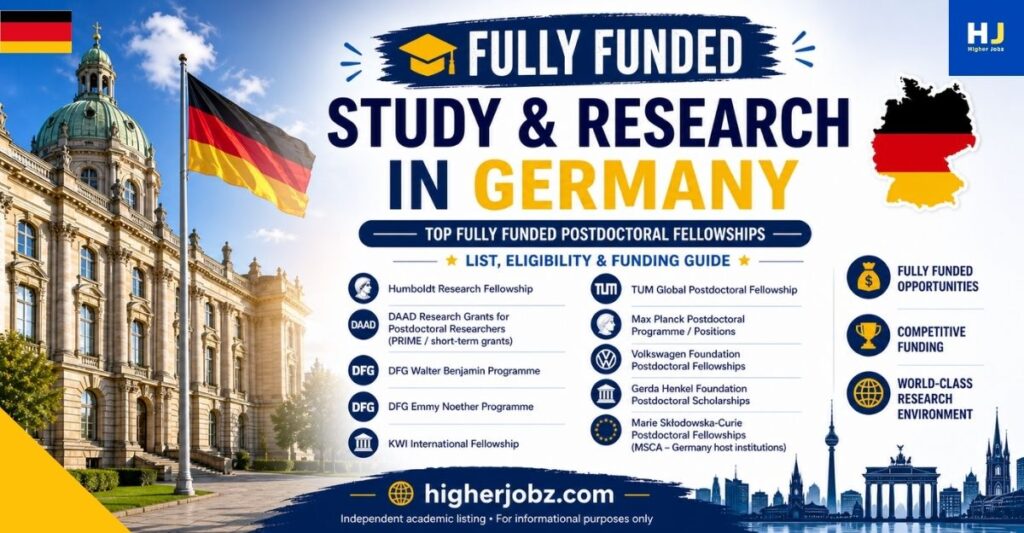
1. Humboldt Research Fellowship
- Fields: Humanities, Social Sciences, Natural Sciences
- Duration: 6–24 months
- Funding: ~€2,700/month + travel + research allowance
- Deadline: Rolling
The Humboldt Fellowship, funded by the Alexander von Humboldt Foundation, is one of the most prestigious programs globally. It allows researchers to conduct independent research with a German host institution and offers long-term academic networking.
2. DAAD Research Grants for Postdoctoral Researchers
- Fields: Humanities, Social Sciences, Natural Sciences (all disciplines)
- Duration: 2–6 months (postdoctoral phase)
- Funding: Fully funded (monthly stipend + travel allowance + health insurance support)
- Deadline: Varies (usually August–October)
The DAAD Research Grants for Postdoctoral Researchers support early-career academics who have already completed their PhD and wish to carry out a short-term research stay at a German university or research institute. This programme allows researchers to work under the supervision of a German academic host while conducting an independent research project.
3. DFG Walter Benjamin Programme
- Fields: All disciplines (strong in humanities & sciences)
- Duration: Up to 24 months
- Funding: Salary + research + travel
- Deadline: Rolling
Funded by the German Research Foundation, this fellowship is ideal for early postdocs seeking independence after their PhD.
4. DFG Emmy Noether Programme
- Fields: Sciences and selected humanities
- Duration: Up to 6 years
- Funding: Full salary + team + research funding
- Deadline: Rolling
Also supported by the German Research Foundation, this program is designed for researchers aiming to lead their own research group.
5. KWI International Fellowship
- Fields: Humanities, Cultural Studies, Social Sciences
- Duration: ~6 months
- Funding: ~€3,000/month + travel
- Deadline: February–March
Hosted by the KWI Institute for Advanced Study in the Humanities, this fellowship is highly respected in humanities research and gives a focused, no-teaching environment.
6. TUM Global Postdoc Fellowship
- Fields: Sciences + interdisciplinary research
- Duration: ~2 years
- Funding: Fully funded salary + research support
- Deadline: November–December
Offered by the Technical University of Munich, this program combines academic excellence with industry collaboration.
7. Max Planck Postdoc Program
- Fields: Natural Sciences + some Social Sciences
- Duration: 2–3 years
- Funding: Fully salaried (TVöD scale)
- Deadline: Rolling / institute-based
The Max Planck Society offers some of the best-funded postdoctoral positions in Europe, with access to cutting-edge research facilities.
8. Volkswagen Foundation Postdoctoral Fellowships
- Fields: Humanities + Sciences (interdisciplinary focus)
- Duration: 1–3 years
- Funding: Salary + research funding
- Deadline: Mid-year (varies)
Funded by the Volkswagen Foundation, this fellowship supports innovative and interdisciplinary projects.
9. Gerda Henkel Foundation Postdoctoral Scholarships
- Fields: Humanities (history, archaeology, cultural studies)
- Duration: 1–2 years
- Funding: Monthly stipend + research support
- Deadline: May / November (varies by call)
The Gerda Henkel Foundation is one of the best options for humanities researchers who want to do research in history, archaeology and related subjects.
10. Marie Skłodowska-Curie Actions (MSCA) Postdoctoral Fellowships (Germany Host)
- Fields: Humanities and Sciences
- Duration: 12–24 months
- Funding: ~€4,000–€5,000/month (including allowances)
- Deadline: September
Funded by the European Commission, this is one of the most competitive and prestigious fellowships in Europe.
Explore the full guide on Marie Skłodowska-Curie Postdoctoral Fellowships
Eligibility and Application Requirements
Most postdoctoral fellowships in Germany require a strong academic background and a clear research proposal. While specific requirements vary, the general criteria include:
- A completed PhD degree (usually within the last 4–6 years)
- Strong academic record with publications in peer-reviewed journals
- A clear and well-structured research proposal
- A confirmed host supervisor or institution in Germany
- Proof of English proficiency (German is optional in most cases)
- Updated academic CV and transcripts
- 2–3 letters of recommendation from academic referees
- Application submitted before the official deadline
Meeting these requirements, along with early preparation and a strong research proposal, can significantly improve your chances of securing a fully funded postdoctoral fellowship in Germany.
Find more postdoctoral positions and short-term fellowships for early-career researchers across disciplines.
Salary and Funding Overview in Germany
Postdoctoral researchers in Germany receive competitive financial support depending on the program.
- Monthly salary range: €4,000–€5,500 (university/research jobs)
- Fellowship stipends: €2,700–€4,500/month
- Additional benefits: health insurance, travel, research funding
Germany provides competitive postdoc salary in Germany structures and fully funded research fellowships in Europe for early career researchers.
How to Choose the Right Fellowship
Selecting the right postdoctoral fellowship in Germany depends on your research area, career goals, and preferred academic environment. Different programs focus on specific disciplines, so choosing wisely can improve both your chances of selection and long-term career growth.
- For humanities: KWI Institute for Advanced Study in the Humanities, Gerda Henkel Foundation, Alexander von Humboldt Foundation
- For sciences: Max Planck Society, Technical University of Munich, German Research Foundation
- For interdisciplinary research: Volkswagen Foundation, European Commission (MSCA)
Always consider key factors such as funding level, fellowship duration, and the reputation of the host institution before applying. Choosing a program that aligns with your research interests will significantly improve your chances of success.
Application Tips
- Start early by identifying and contacting potential supervisors, as early communication significantly strengthens your application
- Prepare a clear, well-structured, and feasible research proposal that aligns with the host institution’s research priorities
- Highlight your international research experience, academic achievements, and publications to demonstrate research competence
- Apply to multiple fellowships strategically to increase your chances of selection and funding success
FAQs
What are the best fully funded postdoc fellowships in Germany?
Top fully funded postdoc fellowships in Germany include Humboldt, DAAD, DFG, Max Planck, and Marie Curie programs.
Is GRE required for postdoctoral fellowships in Germany?
No, GRE is not required for fully funded postdoctoral fellowships in Germany.
How much funding do postdoc fellowships in Germany offer?
Most fully funded postdoc fellowships in Germany provide €2,500–€5,000 per month plus travel and research benefits.
Which fellowships are best for the humanities in Germany?
Top humanities fellowships in Germany include Humboldt, KWI, and Gerda Henkel programs.
What is the duration of fully funded postdoc fellowships in Germany?
Most postdoc fellowships in Germany last between 6 months and 3 years, depending on the program.
Is German language required for postdoc in Germany?
No, most fully funded postdoc positions in Germany require only English proficiency.
Do I need a host supervisor in Germany?
Yes, a confirmed host institution or supervisor is required for most postdoctoral fellowships in Germany.
Are fully funded postdoc fellowships in Germany competitive?
Yes, these fellowships are competitive, so strong research proposals and publications are important.
Conclusion
Germany remains one of the most attractive destinations for postdoctoral researchers in both the humanities and sciences. Its well-funded fellowship programs, internationally recognized institutions, and supportive research environment make it a strong choice for early-career scholars seeking academic growth.
With a clear research plan, careful preparation, and a strong application, you can increase your chances of securing a position at a leading German institution and gain valuable international research experience that can shape your academic career.
Stay updated with the newest fully funded postdoctoral fellowships, scholarships, and global research opportunities on higherjobz.