Introduction: MSCA Funding for Global Research Careers
In today’s academic landscape, research careers increasingly depend on international collaboration, mobility, and access to competitive funding opportunities. One of the most prestigious programmes supporting this vision is the Marie Skłodowska-Curie Actions (MSCA), an initiative funded by the European Union to strengthen research excellence across disciplines.
Named after pioneering scientist Marie Skłodowska-Curie, the programme supports researchers at PhD, postdoctoral, and early-career levels by enabling fully funded international research opportunities. It connects scholars with leading universities, research institutes, and industry partners across Europe and beyond.
Unlike traditional scholarships, MSCA focuses not only on financial support but also on long-term career development. It promotes interdisciplinary training, cross-border mobility, and knowledge exchange, helping researchers build stronger academic profiles and global research networks.
As a result, MSCA has become one of the most respected funding frameworks worldwide, offering a pathway to high-impact research, international exposure, and sustainable academic growth across all major disciplines.
Table of Contents
- Introduction
- What Are Marie Skłodowska-Curie Actions?
- Why MSCA Matters in Academic Careers
- Types of MSCA Funding Programmes
- Eligibility and Application Requirements
- Funding Coverage and Benefits
- How to Apply for MSCA
- Comparison of MSCA Schemes
- Related Research & Funding Opportunities
- FAQ
- MSCA Application Timeline
- MSCA Success Rate
- Conclusion
What Are MSCA – Marie Skłodowska-Curie Actions?
The MSCA programme (Marie Skłodowska-Curie Actions) is a set of research funding initiatives under the European Union designed to promote excellence in science, research, and innovation. It supports international collaboration and enhances global mobility for researchers across disciplines.
MSCA is not a single grant but a portfolio of funding schemes that support:
- Doctoral training programmes
- Postdoctoral research fellowships
- Staff mobility and exchange programmes
- Institutional research collaborations
The core philosophy of MSCA is to strengthen research quality by promoting international mobility, interdisciplinary collaboration, and knowledge exchange across borders.
Learn more about the MSCA – Marie Skłodowska-Curie Actions programme
Why MSCA Matters in Academic Careers
MSCA is considered one of the most competitive and prestigious research funding programmes in the world. It plays a critical role in shaping academic and research careers.
Key reasons why MSCA is important:
- Encourages global research mobility
- Provides fully funded research positions
- Strengthens academic and industry collaboration
- Builds interdisciplinary research skills
- Enhances publication and career prospects
For many researchers, MSCA is not just funding—it is a career transformation platform that significantly improves long-term academic growth and global research opportunities.
Types of MSCA Funding Programmes
MSCA includes several structured funding schemes designed for different stages of academic careers.
A) Doctoral Networks (PhD Level Funding)
Doctoral Networks support structured PhD training programmes across multiple countries and institutions.
Key features:
- Joint supervision between universities
- International research training exposure
- Collaboration with industry partners
- Fully funded PhD salary and mobility support
This scheme is ideal for early-stage researchers who want structured training combined with international experience.
B) Postdoctoral Fellowships
Postdoctoral Fellowships are among the most prestigious MSCA funding opportunities.
They are designed for researchers who have completed their PhD and want to:
- Conduct independent research abroad
- Strengthen academic profiles
- Gain international exposure
- Publish high-impact research
This programme significantly improves career mobility and academic recognition.
C) Staff Exchanges
The Staff Exchanges scheme promotes collaboration between research organisations, universities, and private institutions.
It enables:
- Short-term international mobility
- Knowledge sharing across institutions
- Industry-academia collaboration
- Skill development across sectors
This programme strengthens innovation by connecting different research environments.
D) Co-funding Schemes
Co-funding schemes support national and regional research programmes by co-financing doctoral and postdoctoral positions.
They help institutions:
- Expand research capacity
- Attract international talent
- Improve training standards
- Align with EU research priorities
This strengthens research ecosystems by supporting long-term institutional development.
Eligibility and Application Requirements
MSCA eligibility varies depending on the programme, but general requirements include:
- Open to all nationalities
- Relevant academic background in the research field
- Master’s degree (doctoral schemes) or PhD (postdoctoral schemes)
- Compliance with mobility rule (no recent long-term stay in the host country)
- Strong research proposal aligned with MSCA objectives
Selection is highly competitive and based on:
- Research excellence
- Innovation potential
- Career development impact
- International collaboration value
These criteria ensure that MSCA supports high-quality research with strong academic and global impact.
For eligibility details, visit the official Marie Skłodowska-Curie Actions website: Marie Skłodowska-Curie Actions
Funding Coverage and Benefits
One of the strongest advantages of MSCA is its comprehensive financial and professional support system.
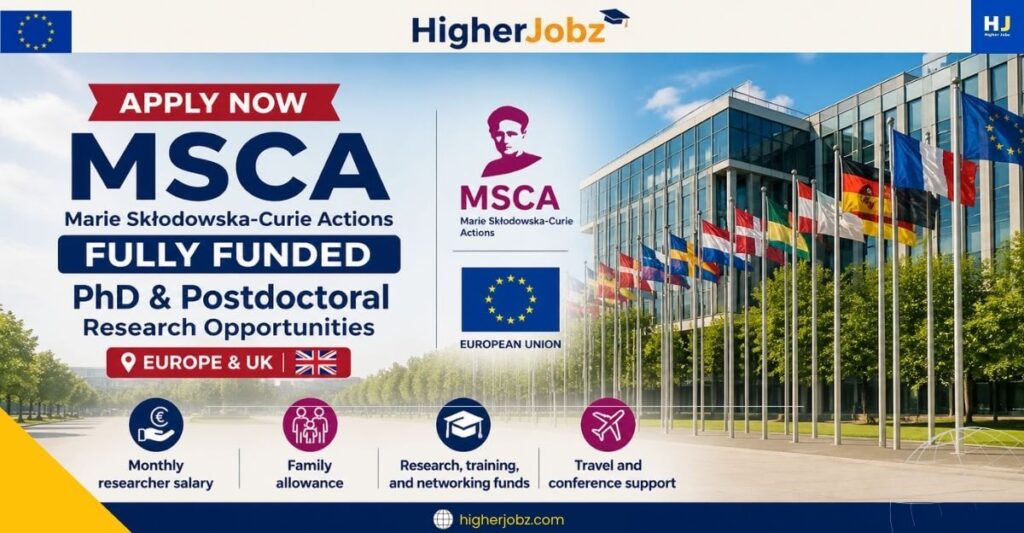
Typical funding includes:
- Monthly researcher salary (stipend)
- Mobility allowance for relocation
- Family allowance (if applicable)
- Research, training, and networking funds
- Travel and conference support
Additional benefits:
- Access to top-ranked global universities
- Structured mentoring and training
- Industry collaboration opportunities
- High publication potential
- Strong international research networks
These benefits make MSCA not just a funding programme, but a complete research career development pathway.
How to Apply for MSCA (Step-by-Step Guide)
Applying for MSCA requires strategic preparation.
Step 1: Identify Research Area
Select a topic aligned with global research priorities, such as:
- Climate and environmental studies
- Artificial intelligence and data science
- Public health and medicine
- Archaeology, history, and heritage studies
- Social sciences and policy research
Step 2: Find a Host Institution
Applicants must collaborate with a university or research organisation that supports their project.
Step 3: Develop Research Proposal
A strong MSCA proposal includes:
- Clear research objectives
- Innovative methodology
- Expected scientific impact
- Strong international collaboration plan
Step 4: Align with MSCA Goals
Your proposal must demonstrate:
- Mobility between countries or institutions
- Interdisciplinary research approach
- Knowledge transfer potential
Step 5: Submit Application
Applications are submitted through official EU funding systems with institutional support.
A well-prepared application significantly improves the chances of selection in this highly competitive programme.
For more details on how to apply for MSCA schemes, visit the official page: “How to apply for funding – Marie Skłodowska-Curie Actions.”
Comparison of MSCA Schemes
| MSCA Scheme | Target Group | Duration | Key Benefit |
|---|---|---|---|
| Doctoral Networks | PhD candidates | Multi-year | Structured PhD training |
| Postdoctoral Fellowships | PhD holders | 1–3 years | Independent international research |
| Staff Exchanges | Research staff | Short-term | Cross-sector collaboration |
| Co-funding Schemes | Institutions | Variable | National research support |
Related Research & Funding Opportunities
- Global PhD Funding Opportunities
- Postdoctoral Fellowships Worldwide
- Archaeology Research Grants and Academic Opportunities
- Humanities Research Opportunities for International Scholars
- International Academic Job Opportunities
- Visiting Research Fellowships and Academic Positions
Frequently Asked Questions (FAQ)
Who can apply for MSCA funding?
Researchers at the PhD or postdoctoral level, depending on the specific scheme.
Is MSCA fully funded?
Yes, MSCA generally covers salary, mobility costs, research expenses, and training support.
Do I need to move to another country?
Yes, international mobility is a core requirement in most MSCA schemes.
Is MSCA only for science subjects?
No, it covers all disciplines, including humanities, engineering, and social sciences.
How competitive is MSCA?
It is highly competitive, with selection based on research quality, innovation, and impact.
Which countries are included in MSCA programmes?
MSCA is open to researchers worldwide, and projects are hosted across EU Member States and associated countries, depending on the specific call and host institution.
Does MSCA provide mobility support?
Yes, MSCA provides strong mobility support, including relocation assistance, travel funding, and allowances to help researchers move between countries for their project.
What are the eligibility criteria for the MSCA?
Applicants must hold the required degree (Master’s or PhD, depending on the scheme), meet MSCA mobility rules, and submit a strong, high-quality research proposal.
MSCA Application Timeline
The Marie Skłodowska-Curie Actions programme generally follows an annual or multi-call cycle depending on the scheme:
- Call Opening: Usually between April and June
- Proposal Submission Deadline: Typically September – October
- Evaluation Period: Around 4–6 months after submission
- Results Announcement: Early the following year
- Project Start Date: Between Spring and Autumn of the next year
This timeline helps researchers plan their proposal development, institutional coordination, and mobility arrangements in advance.
MSCA Success Rate
MSCA is highly competitive due to its global reputation and fully funded structure.
- Average success rate: ~10% to 15% (varies by scheme and call year)
- Postdoctoral Fellowships: Often the most competitive category
- Doctoral Networks: Slightly higher success rate due to consortium-based applications
The low acceptance rate reflects the programme’s emphasis on research excellence, innovation, and international impact, making a strong proposal essential for success.
Conclusion: The Long-Term Value of MSCA
The Marie Skłodowska-Curie Actions remains one of the most influential research funding frameworks in the world. Its strength lies not only in financial support but in its ability to transform academic careers through mobility, training, and global collaboration.
Unlike short-term grants, MSCA builds long-term academic capacity. It empowers researchers to move across borders, engage in interdisciplinary work, and contribute to global scientific challenges.
For more information on application procedures and to apply for MSCA funding schemes, visit the official Marie Skłodowska-Curie Actions application page:
🔗 Official MSCA Website: Marie Skłodowska-Curie Actions
For more international research opportunities and academic positions, you can explore HigherJobz, a platform for academic positions and funding opportunities.