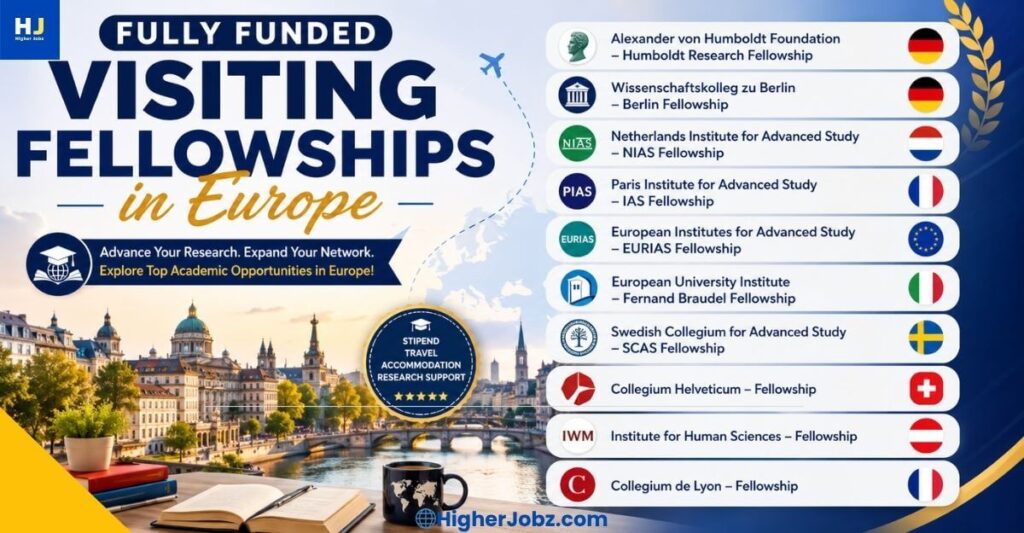
Fully funded visiting fellowships in Europe are among the most competitive and valuable academic opportunities available to researchers, postdoctoral scholars, and senior academics worldwide. These programmes allow scholars to spend a short- to mid-term period at leading European universities or research institutes while receiving full financial support, typically including a monthly stipend, travel costs, accommodation assistance, and research funding.
Beyond financial support, visiting fellowships play a central role in advancing international academic collaboration, increasing research visibility, and strengthening long-term career trajectories. For many researchers outside Europe, these fellowships serve as an important entry point into European academic networks, often leading to postdoctoral roles, collaborative grants, and permanent academic positions.
This article provides a comprehensive guide to funded visiting fellowships in Europe, including major programmes, funding details, eligibility criteria, and application strategies. It is designed to help researchers at all levels understand opportunities, compare options, and plan successful applications for international academic fellowships. Explore top fully funded humanities research fellowships, scholarships, and academic opportunities across leading global universities and research institutions.
Why Apply for Visiting Fellowships in Europe?
Visiting fellowships in Europe offer a unique opportunity to work within some of the world’s most respected research environments. They provide dedicated time, funding, and institutional support to focus entirely on high-quality research.
Key reasons to apply:
- World-class research environment: Access to leading universities and labs
- Full financial support: Includes stipend, travel, and accommodation
- International exposure: Build global academic networks and collaborations
- Strong publication output: Focused research time increases the chances of high-impact publications
- Career progression: Enhances prospects for postdoctoral roles, grants, and faculty positions
For many researchers, these fellowships serve as a gateway to long-term academic opportunities in Europe and beyond.
Table of Contents
- Why Apply for Visiting Fellowships in Europe?
- What Are Visiting Fellowships in Europe?
- Top Visiting Fellowships in Europe
- Comparison of Fellowships
- Eligibility Criteria
- Benefits of Fully Funded Fellowships in Europe
- Application Timeline Strategy
- How to Choose the Right Visiting Fellowship
- Frequently Asked Questions (FAQ)
- Conclusion
What Are Visiting Fellowships in Europe?
Visiting fellowships are temporary, research-focused academic positions hosted by universities or research institutes across Europe. Unlike full-time employment, these fellowships are designed to support independent or collaborative research, usually without teaching or administrative responsibilities.
Most fully funded visiting fellowships include:
- Monthly stipend (€2,000–€5,000 depending on programme)
- Travel allowance (international airfare support)
- Accommodation or housing assistance
- Research funding and project support
- Access to libraries, archives, laboratories, and academic networks
These fellowships are highly valuable for publishing research, building international collaborations, and enhancing academic profiles.
Top Visiting Fellowships in Europe:
Here is a list of the top fully funded visiting fellowships across Europe
1. Alexander von Humboldt Foundation – Humboldt Research Fellowship (Germany)
- Application Cycle: Rolling
- Funding: €2,700–€3,200/month + full benefits
- Duration: 6–12 months
- Level: Postdoctoral and Senior
- Research Fields: All disciplines
Known for its flexibility and prestige, the Humboldt Fellowship allows researchers to conduct independent research at any German host institution while receiving comprehensive financial support.
2. Wissenschaftskolleg zu Berlin – Berlin Fellowship (Germany)
- Application Cycle: Annual
- Deadlines: September–October
- Funding: €3,500–€5,000/month
- Duration: 10–12 months
- Level: Senior Researchers
- Research Fields: Humanities, Social Sciences, Natural Sciences (theoretical focus)
One of Europe’s most selective IAS fellowships, offering a highly interdisciplinary and intellectually stimulating research environment.
3. Netherlands Institute for Advanced Study – NIAS Fellowship (Netherlands)
- Application Cycle: Annual
- Deadlines: Around April
- Funding: ~€3,500/month
- Duration: 5–10 months
- Level: Postdoctoral and Senior
- Research Fields: Humanities and Social Sciences
NIAS provides a fully residential fellowship focused on independent research within a collaborative academic community.
4. Paris Institute for Advanced Study – IAS Fellowship (France)
- Application Cycle: Annual
- Deadlines: Around March
- Funding: €2,500–€3,000/month + accommodation
- Duration: ~10 months
- Level: Postdoctoral and Senior
- Research Fields: Social Sciences, Interdisciplinary
A leading IAS programme in Europe, offering scholars a quiet, well-supported environment for high-level research.
5. European Institutes for Advanced Study – EURIAS Fellowship (Multiple Countries)
- Application Cycle: Annual
- Deadlines: Around June
- Funding: €2,600–€3,800/month + allowances
- Duration: ~10 months
- Level: Postdoctoral and Senior
- Research Fields: Humanities, Social Sciences
EURIAS enables researchers to work across multiple elite IAS institutes in Europe with strong funding and mobility support.
6. European University Institute – Fernand Braudel Fellowship (Italy)
- Application Cycle: Annual
- Deadlines: Around March
- Funding: €3,000–€4,000/month
- Duration: 3–10 months
- Level: Senior Researchers
- Research Fields: Law, Economics, Political Science, History
Hosted in Florence, this fellowship is ideal for advanced scholars working in social sciences and related disciplines.
7. Swedish Collegium for Advanced Study – SCAS Fellowship (Sweden)
- Application Cycle: Annual
- Deadlines: Around June
- Funding: €2,600–€3,800/month
- Duration: 6–12 months
- Level: Senior Researchers
- Research Fields: Humanities, Social Sciences, Theoretical Sciences
SCAS is known for its strong theoretical focus and international research community.
8. Collegium Helveticum – Fellowship (Switzerland)
- Application Cycle: Annual
- Deadlines: March–April
- Funding: CHF 4,000–6,000/month (~€4,000–€6,000)
- Duration: 5–10 months
- Level: Postdoctoral and Senior
- Research Fields: Interdisciplinary (Sciences, Humanities, Engineering)
Offers one of the highest-funded visiting fellowships in Europe within a top Swiss research ecosystem.
9. Institute for Human Sciences – Fellowship (Austria)
- Application Cycle: Annual
- Deadlines: Varies by programme
- Funding: €2,500–€3,500/month
- Duration: 3–10 months
- Level: Postdoctoral and Senior
- Research Fields: Humanities, Social Sciences
A respected centre for advanced research with strong international visibility and interdisciplinary exchange.
10. Collegium de Lyon – Fellowship (France)
- Application Cycle: Annual
- Deadlines: Around January
- Funding: €2,000–€3,000/month + accommodation
- Duration: 5–10 months
- Level: Postdoctoral and Senior
- Research Fields: All disciplines
Provides an interdisciplinary research environment with strong institutional support in France.
Comparison of Fellowships
| Fellowship | Duration | Funding | Country | Level | Competition |
|---|---|---|---|---|---|
| Humboldt Research Fellowship | 6–12 months | €2,700–€3,200 | Germany | Postdoc/Senior | Very High |
| Berlin Fellowship | 10–12 months | €3,500–€5,000 | Germany | Senior | Extremely High |
| NIAS Fellowship | 5–10 months | ~€3,500 | Netherlands | Postdoc/Senior | Very High |
| Paris IAS Fellowship | ~10 months | €2,500–€3,000 | France | Postdoc/Senior | Very High |
| EURIAS Fellowship | ~10 months | €2,600–€3,800 | Europe | Postdoc/Senior | Extremely High |
| Fernand Braudel Fellowship | 3–10 months | €3,000–€4,000 | Italy | Senior | Very High |
| SCAS Fellowship | 6–12 months | €2,600–€3,800 | Sweden | Senior | Very High |
| Collegium Helveticum | 5–10 months | €4,000–€6,000 | Switzerland | Postdoc/Senior | Extremely High |
| IWM Fellowship | 3–10 months | €2,500–€3,500 | Austria | Postdoc/Senior | Very High |
| Collegium de Lyon | 5–10 months | €2,000–€3,000 | France | Postdoc/Senior | High |
Eligibility Criteria
To apply for the best visiting fellowships in Europe, candidates are generally expected to meet the following requirements:
- A PhD degree (for postdoctoral and senior-level fellowships)
- A strong and well-defined research proposal aligned with the host institution
- Publications in peer-reviewed academic journals
- 2–3 academic reference letters
- An official invitation or affiliation with a host institution (in many cases)
- English language proficiency (IELTS/TOEFL, where required)
Browse the latest postdoctoral positions and early career research fellowships globally at higherjobz.
Benefits of Fully Funded Fellowships in Europe
Visiting fellowships in Europe offer far more than financial support. They provide a strong platform for academic growth, international exposure, and long-term career advancement.
Key benefits:
- Full financial support: Monthly stipend, travel allowance, accommodation, and research funding
- Access to top institutions: Work at leading European universities and research centres
- International collaboration: Build global academic networks and research partnerships
- Research productivity: Dedicated time and resources to publish high-quality work
- Career advancement: Strengthens profile for postdoctoral roles, grants, and faculty positions
- Interdisciplinary exposure: Opportunities to engage with diverse fields and methodologies
These fellowships are a strategic step for researchers aiming to expand their academic impact and global visibility. Discover top fully funded postdoctoral fellowships in Germany.
Application Timeline Strategy
Applying for visiting fellowships in Europe requires early and structured preparation. Most top programmes are highly competitive, so planning ahead is essential.
Key timeline:
- 6–12 months before: Choose fellowships, contact host institutions, draft proposal
- 3–6 months before: Finalise research proposal, collect references
- 1–2 months before: Review documents, align with programme goals, submit early
Most deadlines fall between January and June, so missing one cycle means waiting another year.
How to Choose the Right Visiting Fellowship
Choosing the right fellowship depends on your research goals and career stage.
Key factors:
- Research fit: Ensure strong alignment with your field
- Career level: Postdoc vs senior fellowships differ significantly
- Funding vs cost: Consider living costs in each country
- Host strength: Look for strong academic networks and resources
- Duration: Flexible vs fixed-term programmes
A well-matched fellowship increases both acceptance chances and research impact.
Frequently Asked Questions (FAQ)
What is a visiting fellowship?
A funded academic programme allowing researchers to conduct short-term research at European institutions.
Are visiting fellowships fully funded in Europe?
Yes, most provide stipends, travel support, and research funding.
Who is eligible for visiting fellowships?
PhD candidates, postdoctoral researchers, and senior academics, depending on the programme.
Do I need a PhD to apply?
Yes, for most postdoctoral and senior fellowships, but some PhD mobility schemes accept doctoral students.
Do I need a host university before applying?
Many programmes require a host invitation, while others help match candidates after selection.
How competitive are visiting fellowships in Europe?
Highly competitive, especially for top programmes such as Humboldt, EURIAS, NIAS, Berlin IAS, and other leading Institutes for Advanced Study across Europe.
How long should I prepare before applying?
Ideally, 6–12 months to develop a strong research proposal and secure references.
Conclusion
Fully funded visiting fellowships in Europe represent some of the most prestigious academic opportunities globally. They provide not only financial stability but also access to leading research environments, international collaborations, and long-term academic career pathways.
Success in these programmes depends on early preparation, a strong research proposal, and careful alignment between the applicant’s research goals and the host institution’s strengths. For many researchers, these fellowships serve as a transformative step toward building a global academic career.
Stay updated with fully funded postdoctoral fellowships, scholarships, PhD and postdoctoral positions in the UK, MSCA programmes, and global academic career opportunities—visit HigherJobz today.