Introduction
Japan has become one of the most attractive destinations for fully funded research fellowships and international academic collaboration. Known for its globally ranked universities, advanced research infrastructure, and strong government investment in innovation, Japan offers exceptional opportunities for PhD students, postdoctoral researchers, and early-career academics across multiple disciplines.
From artificial intelligence and engineering to archaeology, sustainability, humanities, and digital humanities, Japan’s leading universities and research institutes provide advanced research infrastructure, interdisciplinary collaboration opportunities, and globally connected academic networks that support high-impact international research.
For many international scholars, however, finding reliable information about funded research programs in Japan can be challenging. Funding structures, eligibility criteria, and deadlines often vary across institutions and programmes. This guide simplifies the process by highlighting the top-funded research fellowships in Japan for international researchers.
Whether you are planning doctoral research, postdoctoral mobility, short-term academic exchange, or international collaboration, these fellowships provide financial support, global research exposure, and strong long-term academic career benefits.
Explore the latest fully funded academic opportunities in the humanities and social sciences worldwide.
Table of Contents
- Introduction
- Why Choose Japan for Research Fellowships?
- Top Postdoctoral Fellowships in Japan
- Eligibility and Application Requirements
- Funding & Benefits Overview
- Application Strategy
- How to Choose the Right Fellowship in Japan
- Frequently Asked Questions (FAQ)
- Conclusion
Why Choose Japan for Research Fellowships?
Japan has become one of the world’s leading destinations for global researchers, doctoral scholars, and postdoctoral academics. The country offers a strong combination of research funding, advanced laboratories, global academic collaboration, and internationally respected universities.
Japanese research institutions are known for innovation across STEM fields, humanities, sustainability studies, archaeology, digital humanities, public policy, and interdisciplinary research. With increasing internationalisation and English-language research programmes, Japan is now more accessible than ever for global scholars.
Key Benefits:
- Fully funded fellowships with monthly stipends, airfare, and research support
- Access to globally ranked universities and advanced research institutes
- Strong government investment in science, technology, and academic research
- Opportunities for international collaboration and publication
- English-based research programmes across multiple disciplines
- High-quality research infrastructure and laboratory facilities
- Excellent career development opportunities for PhD and postdoctoral researchers
Japan’s academic ecosystem is particularly attractive for researchers seeking long-term international collaboration, high-impact research environments, and globally recognised academic experience.
Top Postdoctoral Fellowships in Japan
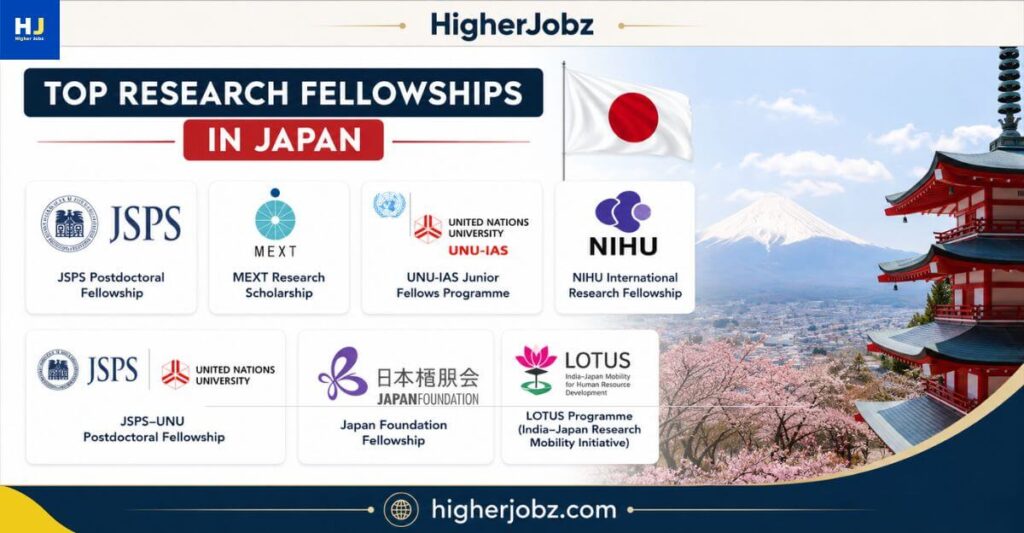
The following are the leading research fellowship programs in Japan:
1. JSPS Postdoctoral Fellowship – Japan
The JSPS Postdoctoral Fellowship is one of Japan’s most well-known international research funding programmes administered by the Japan Society for the Promotion of Science. It supports highly qualified overseas researchers to conduct collaborative research at Japanese universities and institutions.
The programme is primarily designed for early-career researchers with a PhD and requires affiliation with a host researcher in Japan.
- Application Cycle: Annual (via host institution nomination)
- Deadlines: Varies by institution
- Funding: Monthly stipend + airfare + settling-in allowance + insurance
- Duration: 12–24 months
- Level: Postdoctoral Researchers
- Research Fields: Humanities, Social Sciences, Natural Sciences, Engineering
The JSPS Fellowship is widely regarded as one of Japan’s most prestigious postdoctoral research funding schemes for international scholars. Learn more – JSPS.
2. MEXT Research Scholarship – Japan
The MEXT Research Scholarship is a Japanese government-funded programme supporting international students and researchers pursuing graduate-level study or research in Japan.
It covers Master’s, PhD, and non-degree research students at Japanese universities.
- Application Cycle: Annual
- Deadlines: Varies by embassy/university track (typically April–June for embassy route)
- Funding: Tuition exemption + monthly stipend + round-trip airfare
- Duration: 18 months–3 years
- Level: Master’s, Doctoral, and Research Students
- Research Fields: All major academic fields, including humanities and social sciences
MEXT is one of the most widely recognised government scholarships in Japan for international academic study and research. Learn more – MEXT.
3. UNU-IAS Junior Fellows Programme – Japan
The UNU-IAS Junior Fellows Programme is offered by the United Nations University Institute for the Advanced Study of Sustainability in Tokyo. It provides research and professional experience in an international policy-focused academic environment.
It is suitable for graduate students and early-career researchers interested in sustainability and global policy issues.
- Application Cycle: Twice per year
- Deadlines: Mid-year and end-of-year calls
- Funding: Monthly stipend + transportation support (varies by cycle)
- Duration: Around 6 months
- Level: Graduate Students and Early-Career Researchers
- Research Fields: Sustainability, Governance, Development Studies, Public Policy, International Affairs
This programme combines academic research with applied policy experience in a UN institutional setting. Learn more – UNU-IAS.
4. NIHU International Research Fellowship – Japan
The NIHU International Research Fellowship is hosted by the National Institutes for the Humanities in Japan and supports visiting scholars conducting advanced humanities research.
It is intended for experienced researchers and academics working in fields related to Japanese and broader Asian humanities.
- Application Cycle: Annual / institute-based
- Deadlines: Varies by host institute
- Funding: Research support, travel or accommodation support (varies)
- Duration: Several months to 1 year
- Level: Visiting Researchers / Senior Scholars
- Research Fields: History, Linguistics, Anthropology, Religious Studies, Cultural Studies, Folklore
NIHU fellowships are highly respected in humanities research, particularly for Japan-focused academic work. Learn more – NIHU.
5. JSPS–UNU Postdoctoral Fellowship – Japan
The JSPS–UNU Postdoctoral Fellowship is a collaborative programme between the Japan Society for the Promotion of Science and the United Nations University.
It supports postdoctoral researchers working on interdisciplinary topics related to global sustainability and policy.
- Application Cycle: Annual
- Deadlines: Varies by call
- Funding: Monthly stipend + research support
- Duration: 1–2 years
- Level: Postdoctoral Researchers
- Research Fields: Sustainability, Governance, Development Studies, Public Policy, International Relations
The programme combines academic research with international policy-oriented engagement. Learn more – JSPS-UNU.
6. Japan Foundation Fellowship – Japan
The Japan Foundation Fellowship supports researchers in the humanities and social sciences conducting Japan-related studies.
It is especially focused on cultural, historical, and linguistic research requiring access to Japanese institutions and resources.
- Application Cycle: Annual
- Deadlines: Varies by category
- Funding: Research allowance + travel + living support
- Duration: Short-term to long-term options
- Level: Researchers and Academics
- Research Fields: Japanese Studies, Cultural Studies, History, Literature, Anthropology, Religion
It is one of the leading fellowships for Japan-focused humanities research internationally. Learn more – Japan Foundation.
7. LOTUS Programme – India–Japan Research Mobility Initiative
The LOTUS Programme is a collaborative India–Japan academic mobility initiative supporting joint research and institutional cooperation between researchers in both countries.
It focuses on research exchange, collaboration, and capacity building across disciplines.
- Application Cycle: Varies by call
- Deadlines: Institution-dependent
- Funding: Mobility and collaborative research support
- Duration: Project-based
- Level: Researchers and Institutions
- Research Fields: Humanities, Social Sciences, Science and Technology, Interdisciplinary Research
The programme strengthens academic collaboration between India and Japan through research mobility and joint projects. Learn more – LOTUS Programme.
Eligibility and Application Requirements
Most Japanese research fellowships for international students, postdoctoral researchers, and humanities scholars require a strong academic profile and a well-prepared research proposal. While eligibility criteria vary by programme, the general requirements usually include:
- A completed Master’s or PhD degree from a recognised university
- Strong academic record with publications or research experience
- A clear and well-structured research proposal
- A confirmed Japanese host professor or institution (required for many fellowships)
- Proof of English proficiency (Japanese language skills are optional for most programmes)
- Updated academic CV, transcripts, and degree certificates
- Two or three recommendation letters from academic referees
- Submission of all application materials before the official deadline
Most prestigious Japanese programmes such as JSPS, MEXT, NIHU, and the Japan Foundation Fellowship are highly competitive. Early preparation, strong academic writing, and direct communication with potential Japanese supervisors can significantly improve your chances of receiving a fully funded research fellowship in Japan.
Find more fully funded scholarships, postdoctoral fellowships, and humanities research opportunities in Japan for international students and early-career researchers.
Funding & Benefits Overview
Academic funding opportunities in Japan for international students, postdoctoral researchers, and humanities scholars provide substantial financial and academic support. While benefits vary by programme, prestigious Japanese fellowships such as JSPS, MEXT, The Japan Foundation Fellowship, NIHU, and UNU programmes commonly offer:
- Monthly stipend for living expenses
- Full or partial tuition fee coverage
- Round-trip international airfare
- Research and fieldwork funding
- Access to libraries, archives, and research facilities
- Institutional affiliation with Japanese universities or research centres
- Health insurance or medical support (in some programmes)
- Opportunities for international academic networking and collaboration
Many academic fellowships in Japan are designed to support long-term academic research, interdisciplinary collaboration, archival work, and international mobility for humanities and social science researchers.
These programmes are especially valuable for scholars in history, anthropology, literature, cultural studies, archaeology, religion, political science, and Japanese studies seeking research opportunities in Japan.
Application Strategy
Securing a fully funded fellowship in Japan requires early preparation, a strong research profile, and a highly focused application strategy. Competitive programmes such as JSPS, MEXT, NIHU, and The Japan Foundation Fellowship prioritise applicants who demonstrate academic clarity, research feasibility, and alignment with Japanese institutions.
- Identify the most suitable fellowship based on your academic level and research field
- Develop a clear, focused, and original research proposal aligned with Japan-based resources or expertise
- Contact potential Japanese host professors or institutions well in advance (especially for JSPS and NIHU programmes)
- Strengthen your academic profile through publications, fieldwork experience, or conference presentations
- Prepare a strong academic CV, writing samples, and recommendation letters
- Carefully follow official guidelines and submit applications before deadlines
- Tailor each application to highlight why Japan is essential for your research project
A well-planned application strategy, combined with strong academic credentials and early engagement with Japanese institutions, significantly increases the chances of success in top-tier Japanese research fellowships.
How to Choose the Right Fellowship in Japan
Choosing the right fellowship in Japan is one of the most important steps for securing a fully funded research opportunity. Different fellowships, such as JSPS Postdoctoral Fellowship, MEXT Research Scholarship, The Japan Foundation Fellowship, NIHU Fellowship, and UNU-IAS Junior Fellows Programme, are designed for different academic levels and research fields.
Understanding the structure of each Japan fellowship helps applicants match their profile with the right funding opportunity in the humanities, social sciences, and interdisciplinary research.
- Select MEXT Research Scholarship if you are a master’s, PhD, or early-stage researcher looking for fully funded degree-based study or research in Japan
- Select the JSPS Postdoctoral Fellowship if you already hold a PhD and want to pursue advanced postdoctoral research in Japan with strong international collaboration opportunities
- Select the Japan Foundation Fellowship if your research is focused on the humanities in Japan, including Japanese studies, cultural studies, history, literature, or anthropology
- Select the NIHU International Research Fellowship if you are a visiting researcher or senior scholar working on cultural heritage, history, linguistics, religion, or archival research in Japan
- Select the UNU-IAS Junior Fellows Programme if your research interest is in sustainability, governance, public policy, development studies, or international affairs
- Match your research proposal with Japan-based academic strengths, such as universities, archives, research institutes, and fieldwork locations
- Choose fellowships based on funding duration, whether short-term research or long-term academic projects are required
- Carefully check the eligibility criteria for each fellowship in Japan before applying
- Select programmes that align with your academic stage, research experience, and publication record
- Focus on fellowships that support your long-term goal of building an academic career in the humanities, social sciences, or interdisciplinary research
Selecting the right research fellowship in Japan increases your chances of approval and ensures better academic outcomes.
Related International Research Fellowships & Funding Opportunities
- Fully funded visiting fellowships in Europe
- Postdoctoral fellowship opportunities
- MSCA PhD and postdoctoral funding guide
- UPenn scholarships and international fellowships
- UK research fellowships 2026
- Top Postdoctoral Fellowship in Germany
Frequently Asked Questions (FAQ)
What are the top Japan fellowships?
Top fully funded fellowships in Japan include JSPS Postdoctoral Fellowship, MEXT Scholarship, The Japan Foundation Fellowship, NIHU Fellowship, and UNU-IAS Junior Fellows Programme.
Who can apply for Japan fellowships?
International students, Master’s students, PhD candidates, postdoctoral researchers, and senior scholars can apply depending on eligibility.
Are Japan fellowships fully funded?
Yes, most major Japanese fellowships in Japan are fully funded and include a stipend, airfare, and research support.
What fields are eligible for Japan research fellowships?
Humanities, social sciences, history, anthropology, literature, archaeology, political science, and cultural studies are commonly supported.
Can I apply without Japanese language?
Yes, most Japan fellowships accept English applications. Japanese is not required.
Is JSPS harder than MEXT?
Yes, JSPS is more competitive than MEXT.
Can I stay in Japan after the fellowship?
Yes, but you need to apply for a separate visa or job.
How competitive is JSPS Postdoctoral Fellowship?
Very competitive; selection depends on strong research proposal, publications, and a Japanese host.
Do Japan fellowships require Japanese language?
No, most are in English. Japanese is optional but useful for daily life.
Which fellowship is easiest for the humanities?
MEXT and Japan Foundation Fellowships are generally easier for humanities applicants.
Conclusion
Fully funded fellowships in Japan, like JSPS, MEXT, NIHU, The Japan Foundation, and UNU-IAS, offer strong long-term value for international researchers in the humanities and social sciences. They provide funding, global exposure, and access to top research institutions.
These Japanese fellowship schemes can significantly boost your academic career through international publications, collaborations, and research experience.
Success depends on early preparation, a strong research proposal, and choosing the right fellowship in Japan based on your academic level and goals.
Start preparing early to improve your chances of securing a fully funded research fellowship in Japan.
Stay updated with the latest fully funded research fellowships, postdoctoral opportunities, and global academic career pathways—visit HigherJobz today.